July 28, 2026
  5 min read
Imagine seeing a doctor today. They take your history, run tests, document your medications, note your allergies, and flag a concern they want to follow up on next month. Then imagine that the next time you need care at an emergency room across the city, a free clinic run by volunteers, or a mobile health van, none of that information is available.
The physician in front of you starts from zero. They ask the same questions. They may duplicate tests. They may miss the medication interaction that the previous provider flagged. They make decisions without context not because they are not competent, but because the system has no way to give them what they need.
For most Americans, this fragmentation is an inconvenience. For the homeless and uninsured people who cycle through emergency rooms, shelters, free clinics, and mobile health services; it is a daily medical reality, and a dangerous one.
Why Medical Records Get Lost
Medical records in the United States are stored by the provider or health system that generated them, not by the patient they belong to. This model works reasonably well for people with stable housing, stable insurance, and a consistent primary care physician. It fails almost entirely for people who don’t.
An unhoused individual may receive care from a rotating cast of providers across multiple institutions; none of which share a common electronic health record system. A patient leaving incarceration enters the healthcare system with no accessible medical history. A person in addiction recovery who relocates for treatment starts over with every new provider.
The records exist, in theory. But they are siloed in systems that don’t talk to each other, held by organizations that may require insurance or a permanent address to release them, and formatted in ways that even well-meaning providers cannot quickly access or use.
The result is that the patients most likely to have complex, layered medical histories are the ones least likely to have those histories available at the point of care.
What a Patient-Owned Universal Medical Record Changes
A patient-owned universal medical record inverts this model. Instead of records residing with providers and institutions, they reside with and are controlled by the patient. Every encounter, every test result, every prescription, every diagnosis is added to a single longitudinal record that the patient carries with them.
This is not a new idea in theory. What is new is the combination of technologies-cloud infrastructure, secure mobile access, interoperability standards, and AI-assisted data organization, that make it practically achievable at scale, including for populations without consistent device access.
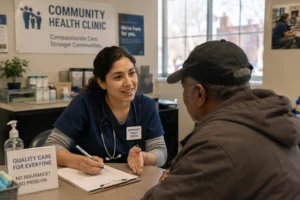
The implications for vulnerable populations are significant. A shelter resident who sees three different providers in a month can arrive at each encounter with a complete, current medical history. A patient discharged from the emergency room can share their records with the follow-up clinic automatically. A physician in a free clinic staffed by rotating volunteers can make informed decisions from the first visit, not the fifth.
AI as the Coordination Layer
A universal record becomes dramatically more powerful when paired with AI-assisted care coordination. Not AI replacing clinical judgment, but AI doing the organizational and pattern-recognition work that no single clinician can do manually across a complex patient history.
That means surfacing relevant history at the moment of a clinical encounter. Flagging potential drug interactions when a new medication is prescribed. Identifying patterns across visits that might indicate a developing condition. Generating care summaries that let a new provider get up to speed in minutes rather than hours.
In settings with high clinician turnover, limited appointment time, and patients presenting with complex, multi-system conditions, this kind of intelligent support is not a luxury. It is the difference between care that is responsive to the whole person and care that responds only to today’s presenting complaint.
Privacy, Ownership, and Trust
Any discussion of a universal medical record must take privacy seriously and particularly the privacy of populations who have reason to distrust institutions that hold data about them.
A patient-owned record model addresses this directly: the patient controls who sees their data and when. They can grant access to a provider for a specific encounter and revoke it afterward. They are not dependent on institutions to share data on their behalf, or to protect it appropriately.
Building trust with communities that have historically experienced healthcare as a site of harm rather than healing; requires demonstrating that their data belongs to them, and that the system is designed to serve them rather than to extract from them. This is a design principle, not a feature. It has to be built in from the beginning.
What the Renewed Recovery Foundation Is Building Toward
The Renewed Recovery Foundation’s commitment to a patient-owned universal medical record is not a technology bet, it is a care philosophy made concrete. We believe that a person’s medical history belongs to them. That care should follow the patient, not the payor. And that the innovations we build for the most vulnerable populations will ultimately make care better for everyone.
This work sits at the intersection of our charitable clinic operations, our AI and digital health initiatives, and our translational research mission. It requires technology partners, healthcare system partners, policy advocates, and funders who understand that fixing the infrastructure of care is just as important as funding the care itself.
Join the Mission
A medical record is not an administrative document. It is the story of a person’s health, a story that should never be lost, no matter where they sleep, where they seek care, or how many times life has required them to start over.
If you want to be part of building a system that keeps that story intact, we invite you to join us.
Renewed Recovery Foundation is a registered 501(c)(3) nonprofit organization. Contributions are tax-deductible to the extent allowed by law.